Creating the perfect label starts with knowing the basic principles and tools needed to engineer them accurately.
Let us provide you with everything you need to create that perfect label for your customers. Get started now—contact us to request a free copy of our handy label pocket guide.
For more details, see our in-depth Label Resource Guide, or select from the above links.
Custom Label Dimensions
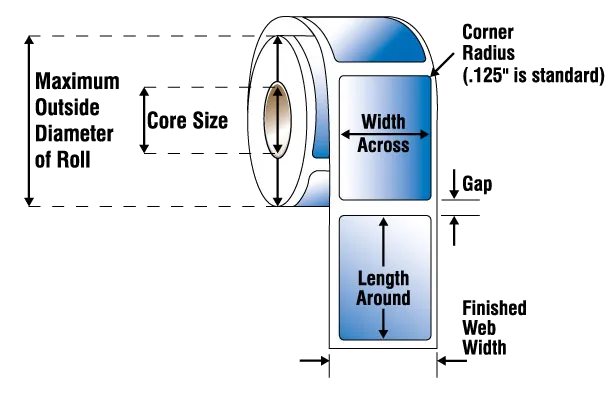
Not sure how to measure a label? Take a look at the diagram below to see the standard method of measuring labels and rolls.
Many people feel that a pressure sensitive label can be applied successfully to everything. Not true! There are some surfaces to which pressure sensitive labels will not adhere at all. The key to success in any label application is to test the face material and adhesive prior to the label order being placed. This simple process will prevent problems from occurring later. Three important things to consider:
- Should your adhesive be permanent or removable?
- Should you use acyrlic or rubber-based adhesive?
- What performance factors should you consider?
The performance of adhesives is dependent on three measurable factors:
Tack
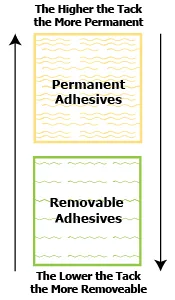
Tack defines the degree to which an adhesive will stick to a surface on first contact. Tack allows an adhesive on a pressure sensitive label to “wet” a surface and form an appropriate bond. The tack increases on smooth or heated surfaces (high surface energy) and decreases on rough or cold surfaces (low surface energy). See chart below. Tack can be laboratory tested by measuring the amount of force needed to peel it away from a substrate.
- Low tack – defines an adhesive which, all other conditions being equal, has a low initial grab.
- High tack – defines an adhesive which, all other conditions being equal, has a high initial grab.
Adhesive performance is highly dependent on its contact with a surface–it should be applied with firm pressure on a dry surface that is free of contaminates.
Specific Adhesion
Specific adhesion is an adhesive’s ability to stick/adhere to a surface after it has been allowed to fully set. A minimum of 24 hours, preferably 72, should be allowed for the adhesives to set before determining whether the product has the proper amount of adhesion. An adhesive may bond well to one surface such as glass, but poorly on another such as polyethylene. Adhesion qualities can be tested by measuring the amount of force needed to peel away the label from various surfaces under specific bonding and conditioning circumstances.
Cohesiveness
The internal strength of an adhesive is its cohesiveness. To prevent a label from splitting when removed from a surface, the cohesive strength has to be greater than the specific adhesion. One method of measuring the cohesive strength of a label adhesive is by vertically bonding a label sample to a test bar. A weight is then attached to the sample. The amount of time that elapses before the sample pulls free of the bar is a measure of shear strength.
To best determine how your label will be used, review the following label characteristics:
Dimensions - Determine your label dimensions with an accurate drawing that includes (but is not limited to) the width, length, corner radius, and position and diameter of interior cuts, orientation to the roll, or sheet. See a diagram on how to measure a label.
Material - The type of materials you use for your label are very important. There are many factors to consider in your choice, including it's inteded use, life span, the surface it will be applied to, and more. Learn more here. You can also look at our available face stocks and adhesives.
Copy - This refers to the copy and design that will be printed on the label. The orientation of the copy to the label width, length and roll or sheet, is very important to the document.
Colors and Color Breaks - Verify your label colors with PMS charts and remember to consider the label material's background color. PMS colors will look different on label stocks such as films, fluorescents, and foils. Digital printing will not match PMS swatch books-they're only used as a matching reference. See our standard PMS colors.
Protective Coatings - A protective coating is recommended if your label is exposed to chemicals, moisture, extreme temperatures, or frequent contact by human hands. Types of protective coatings include UV clear coat and lamination.