Envelopes are your first impression for whatever products you're selling or message you must convey. As a premier envelope supplier, Western States has the expertise to make that critical first impression exactly what you want it to be.
Think of this section as your tool for tapping into the profitability envelopes can bring to your business.
This comprehensive Envelopes 101 section will help you:
- Determine the perfect size and shape of an envelope for your customers' needs.
- Understand and comply with federal guidelines for mailing envelopes.
- Create any quality envelope you can imagine.
Please select from one of the categories to get started.
Learn Envelope Basics
As a premier national envelope supplier, Western States has the experience and expertise to provide solutions for you and your customers. From business envelopes to announcement envelopes and everything in between ... we're here to supply you with the envelope know-how you will need to succeed.
An Envelope’s Parts
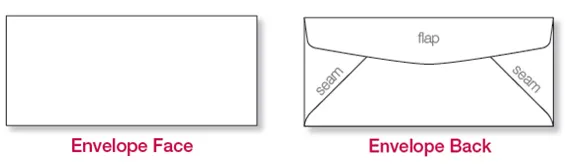
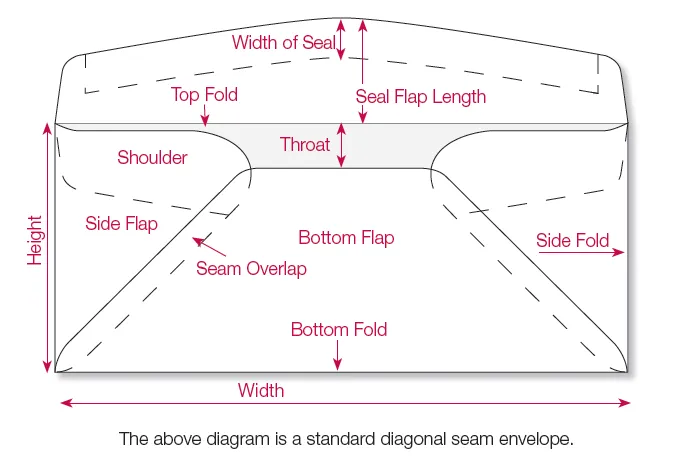
Regardless of size or variations, an envelope has the same basic parts: corners, flaps, folds, shoulders, throat, seal and seams.
How to Measure an Envelope
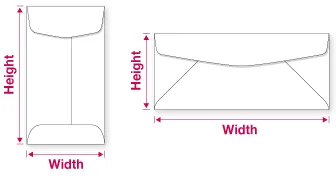
Although envelopes are measured from the shortest dimension first, this practice does not distinguish the height from the width. Therefore, if the envelope is placed before you with its seal flap at the top, the dimension from the bottom fold to the top fold is the height. The dimension from the left to right is the width. Simply considering the position of the flap is the first step in describing envelopes. You can find a helpful list of standard envelope sizes.
Not sure how to measure 1/16's or 1/8's? You can learn more here.
How to Measure Window Positions
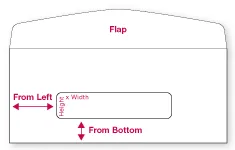
Window size is always specified as height x width regardless of orientation. Window positions are always measured by their distance from the left edge of the envelope and the distance from the bottom (the flap is the "top" of the envelope). If you would like to view and download window templates, please visit our templates page. These templates should be used for window reference only and should not be used for creating and sending envelope artwork. If you need help with your envelope artwork, please contact customer service.
How to Measure Expansion Envelopes
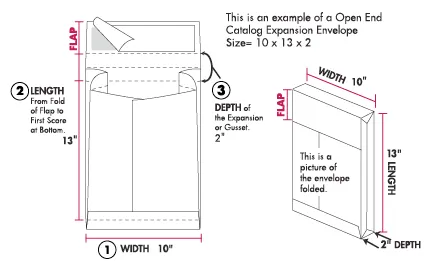
- First - determine the "width" of the envelope. The width is always the shorter measurement. When an envelope opens on the shortest side it is called a catalog envelope or an open end envelope.
- Second - determine the "length" of the envelope. The length is always the longer measurement without including the flap. When an envelope opens on the longest side it is called a booklet envelope or an open side envelope.
- Third - determine the "depth" of the expansion. That is the thickness that the envelope expands to. This is sometimes referred to as the Gusset.
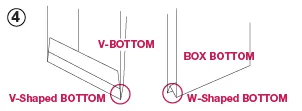
- Fourth - determine the envelopes "bottom" shape. V (V-Bottom) or W (Box Bottom)
Also see our tips on how to measure a block size.
Common Envelope Styles
With thousands of different styles of envelopes on the market, it can sometimes be a bit overwhelming to look at them all at once. That's where styles come in—by helping you to narrow down the exact type of envelope to fit your needs.
Common styles include:
Commercials (Regulars)
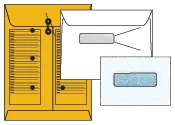
Commercials are the most common style of business envelopes. They're typically used for most correspondence and billing, with the most popular being the #10 regular. The sizes of commercials range from a #5 (smallest) to a #14 (largest). Commercials are open side envelopes, with or without windows. See our available commercials. See our available commercials
A-Series / Announcements / Baronials
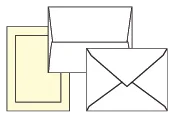
Announcement envelopes typically have either deep pointed flaps and diagonal seams or deep square flaps with two side seams. They are used with baronial cards, informal mailings, and social and commercial announcements. This style envelope is enhanced by the use of many kinds of paper stocks. Announcements range from sized A-2 to A-10. See our available announcements and baronials
Catalogs and Booklets
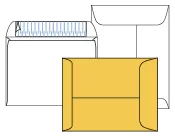
Catalog and booklet envelopes are available in two distinct styles - Open End Catalogs open on the short dimension, and Open Side Booklets open on the long dimension. Catalogs and booklets typically have heavily gummed flaps or utilize Pres-stik or Kwik-tak seals to protect their contents. These envelopes are typically used for catalogs, books, manuals, or documents. See our available catalog and booklet envelopes
Office / Professional
Specialty envelopes are all the styles that fall in between the ones listed above. They are often designed to mail or hold something outside of your average documents. Ranging from CD Mailers to collections to bubble mailers, there is a style of envelope for just about any need. See our office and professional products.
Standard Envelope Sizes & Styles
When it comes to ordering an envelope, it's important to understand which sizes are standard and most popular. Listed below is a wide range of standard sizes for a variety of different envelope types and styles.
Looking for a quick reference in your office? Request a complimentary copy of our Envelope Wall Chart.
Commercials
| Envelope # |
Dimensions (inches) |
Max. Enclosure Size (inches) |
Dimensions (Millimeters) |
Max. Enclosure Size (Millimeters) |
| #5 |
3-1/8 x 5-1/2 |
2-7/8 x 5-1/4 |
79 x 140 |
73 x 133 |
| #6-1/4 |
3-1/2 x 6 |
3-1/4 x 5-3/4 |
89 x 146 |
83 x 146 |
| #6-3/4 |
3-5/8 x 6-1/2 |
3-3/8 x 6-1/4 |
92 x 165 |
86 x158 |
| #7 |
3-3/4 x 6-3/4 |
3-1/2 x 6-1/2 |
95 x 171 |
89 x 165 |
| #7-1/2 |
3-15/16 x 7-1/2 |
3-11/16 x 7-1/4 |
100 x 191 |
94 x 184 |
| #8-5/8 |
3-5/8 x 8-5/8 |
3-3/8 x 8-3/8 |
92 x 219 |
86 x 213 |
| #9 |
3-7/8 x 8-7/8 |
3-5/8 x 8-5/8 |
98 x 225 |
92 x 219 |
| #10 |
4-1/8 x 9-1/2 |
3-7/8 x 9-1/4 |
105 x 241 |
98 x 241 |
| #11 |
4-1/2 x 10-3/8 |
4-1/4 x 10-1/8 |
114 x 264 |
108 x 257 |
| #12 |
4-3/4 x 11 |
4-1/2 x 10-3/4 |
121 x 279 |
114 x 273 |
| #14 |
5 x 11-1/2 |
4-3/4 x 11-1/4 |
127 x 292 |
121 x 286 |
(Note: These are only standard sizes, to view all of our available sizes and styles, you can Browse our Products or View Our Catalog.)
Catalogs
| Dimensions (inches) |
Max. Enclosure Size (inches) |
Dimensions (Millimeters) |
Max. Enclosure Size (Millimeters) |
| 6 x 9 |
5-3/4 x 8-3/4 |
152 x 229 |
146 x 222 |
| 6 x 9-1/2 |
5-3/4 x 9-1/4 |
152 x 241 |
146 x 235 |
| 6-1/2 x 9-1/2 |
6-1/4 x 9-1/4 |
165 x 241 |
158 x 235 |
| 7-1/2 x 10-1/2 |
7-1/4 x 10-1/4 |
191 x 267 |
184 x 260 |
| 9 x 12 |
8-3/4 x 11-3/4 |
229 x 305 |
222 x 298 |
| 9-1/2 x 12-1/2 |
9-1/4 x 12-1/4 |
241 x 318 |
235 x 311 |
| 10 x 13 |
9-3/4 x 12-3/4 |
254 x 330 |
248 x 324 |
| 10 x 15 |
9-3/4 x 14-3/4 |
254 x 381 |
248 x 375 |
| 12 x 15-1/2 |
11-3/4 x 15-1/4 |
305 x 394 |
298 x 387 |
(Note: These are only standard sizes, to view all of our available sizes and styles, you can Browse our Products or View Our Catalog.)
Announcements
| Envelope # |
Dimensions (inches) |
Max. Enclosure Size (inches) |
Dimensions (Millimeters) |
Max. Enclosure Size (Millimeters) |
| A-2 |
4-3/8 x 5-3/4 |
4-1/8 x 5-1/2 |
111 x 146 |
105 x 140 |
| A-6 |
4-3/4 x 6-1/2 |
4-1/2 x 6-1/4 |
114 x 165 |
114 x 159 |
| A-7 |
5-1/4 x 7-1/4 |
5 x 7 |
133 x 184 |
127 x 180 |
| A-8 |
5-1/2 x 8-1/8 |
5-1/4 x 7-7/8 |
140 x 206 |
133 x 200 |
| A-9 |
5-3/4 x 8-3/4 |
5-1/2 x 8-1/2 |
146 x 222 |
140 x 216 |
| A-10 |
6 x 9-1/2 |
5-3/4 x 9-1/4 |
152 x 241 |
146 x 235 |
(Note: These are only standard sizes, to view all of our available sizes and styles, you can Browse our Products or View Our Catalog.)
Coins
| Envelope # |
Dimensions (inches) |
Dimensions (Millimeters) |
| 00 |
1-11/16 x 2-3/4 |
43 x 70 |
| 1A |
2-1/4 x 3-1/2 |
57 x 89 |
| 2AA |
2-1/2 x 3-1/2 |
63 x 89 |
| 3B |
2-1/2 x 4-1/4 |
63 x 108 |
| 4-1/4D |
3 x 4-7/8 |
76 x 124 |
| 5E |
2-7/8 x 5-1/4 |
73 x 133 |
| 5-1/2F |
3-1/8 x 5-1/2 |
79 x 140 |
| 6G |
3-3/8 x 6 |
85 x 152 |
| 7H |
3-1/2 x 6-1/2 |
89 x 165 |
(Note: These are only standard sizes, to view all of our available sizes and styles, you can Browse our Products or View Our Catalog.)
Collections
| Envelope # |
Dimensions (inches) |
Max. Enclosure Size (inches) |
Dimensions (Millimeters) |
Max. Enclosure Size (Millimeters) |
| #6-1/4 |
3-1/2 x 6-1/4 |
3-1/4 x 6 |
89 x 159 |
83 x 152 |
| #6-3/4 |
3-5/8 x 6-1/2 |
3-3/8 x 6-1/4 |
92 x 165 |
86 x 159 |
| #9 |
3-7/8 x 8-7/8 |
3-5/8 x 8-5/8 |
98 x 225 |
92 x 219 |
(Note: These are only standard sizes, to view all of our available sizes and styles, you can Browse our Products or View Our Catalog.)
Envelope Design - Seals & Closures
We offer and stock a wide variety of envelope seals and closures, including:
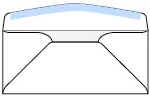 |
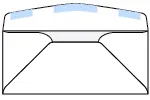
Remoistening Seal - A gum seal activated by moistening the flap for a permanent seal.
|
 |
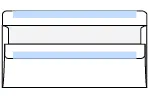
Split Seal - A gum seal split into sections and activated by moistening the flap for a permanent seal; better for storing envelopes in humid conditions.
|
 |
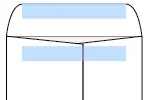
Flip-Stik Seal - Latex adhesive applied on two flap surfaces and folded to keep them separated until sealing; no moisture required.
|
 |
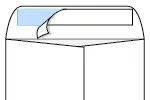
Pres-Stik® - Self-adhering latex adhesive applied to two surfaces that seals on contact when joined.
|
 |
Kwik-Tak® - Release tape liner applied over a resin adhesive pressure sensitive seal. Remove liner and press flap down to seal; no moisture required.
|
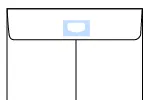 |
Multi-Tak™ - Seal tape closure for reusable sealing; can be printed after conversion.
|
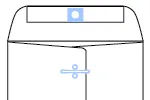 |
Clasp - Reinforced, double-pronged metal clasp for added security. Should not be run through automated processes after conversion.
|
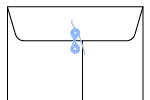 |
String & Button - Tie-down closures ready for repeat opening or secured sealing.
|
Envelope Design - Seams & Flaps
When it comes to envelope design, it's best to understand and consider each of it's parts. This will help you dial in on the perfect stock product or custom create an envelope to fit your needs!
Types of Seams
Variations include:
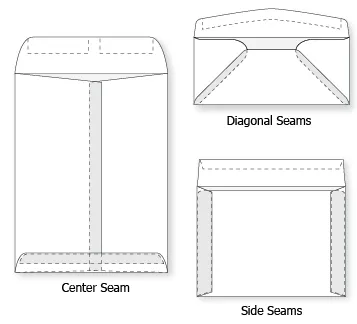
Center Seams – Most commonly used on coin and catalog envelopes.
Diagonal Seams – Used on commercials and pointed flap baronials.
Side Seams – Provide a large area for printing on the back, as in reverse face, collection and booklet envelopes.
Weld Seams – Eliminate die cutting and can be produced to permit insertion and trimming in a magazine. The envelope’s pocket size is determined by the distance between the internal gum lines.
Types of Flaps
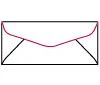 |
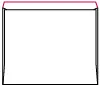
Bankers – Used on commercial style envelopes to provide additional sealing area.
|
 |
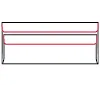
Extension – Constructed without a flap, but rather with an extension of the face, neither gummed nor scored, to assist with material insertion.
|
 |
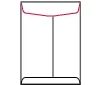
Flip-Stik – Latex adhesive is applied on two flaps and separated until sealing.
|
 |
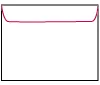
Hub – Used on catalogs.
|
 |
Cheese Blades – Used on booklets and machine insertables.
|
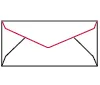 |
Monarch – Used on #7-1/2 envelope flaps.
|
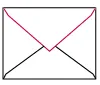 |
Pointed – Used on most baronials.
|
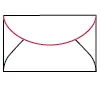 |
Round – Used on some small coin, drug and pay envelopes.
|
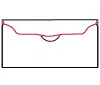 |
Scalloped – Used on our Church Offering envelopes.
|
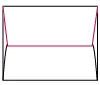 |
Square – Used on announcements and some booklets.
|
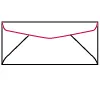 |
Standard Commercial Flap – Used on commercials.
|
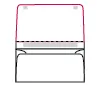 |
Wallet – Provide additional area for printing on both the back and seal flap; used on dual purpose, some commercials, collections, and order-form envelopes.
|