
You are running a Trial version of Nop Mega Menu

Western States History

The unending pursuit to be an industry leader started for Western States Envelope Company in 1908. That was the year George French Moss left the paper selling business and opened the Company's first location on 1st Street, in downtown Milwaukee, Wisconsin. An ambitious entrepreneur and visionary, Moss wanted to create an enterprise for producing unique, reliable envelopes. In fact, Western States was a pioneer in developing a system for printing envelopes flat before folding.

Growth ever since those early days has been continuous, substantial and rapid. By 1922, Western States Envelope Company grew exponentially within the U.S. and housed one of the world's largest inventories that year.

Western States kept growing into the 1960s and 1970s, the Company continued to make production technology a priority. They became a sort of "Industry Mecca" for the latest envelope printing and production equipment.

That commitment to innovation still holds strong today. It's this progressive spirit combined with exceptional service that sets Western States Envelope & Label apart in the industry.

To view a specific period throughout our history, click on the links in the top navigation.

You can also learn more about the history of envelopes in this publication by Maynard H. Benjamin.
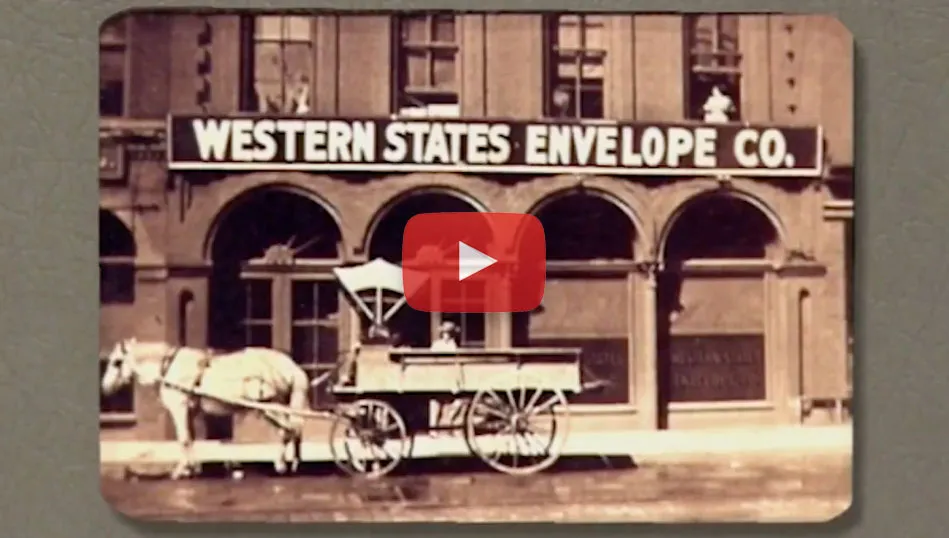
Western States History
1908 Western States Envelope Company is incorporated. Founders include George F. Moss, T.J. Taylor, Robert Kerr, and Hans P. Johnson. T.J. Taylor is president. The first Western States Envelope Company plant is located on E. Water Street in downtown Milwaukee, Wisconsin.
1909 George F. Moss is elected Vice President and Treasurer.
1913 Theodore Roosevelt is shot while riding in the car of founder George F. Moss in downtown Milwaukee, Wisconsin.
1914 More machinery is purchased for business advancement.
1915 George F. Moss is elected President/Treasurer.
1917 The plant is moved to South Water and Ferry St.
1919 Envelope manufacturing reaches 18 million.
1920 An instruction manual was created for the operation of a box machine and very large envelopes. An envelope sample cabinet is created showing every style of envelope the company can make. A new sales agent is added in Chicago, Illinois.
1922 An envelope portfolio and a new price list are created..."a real business getter." A new machine attachment which helps to jog envelope blanks is patented.
1923 The new building is expanded and a new annex is added for $10,000.
1924 George B. Moss, son of George F. Moss, is promoted into sales. A new factory building on West Pierce in Milwaukee is purchased. 
1925 Sales are small but new efficient machinery helps the company realize a profit.
1928 Four new rotary machines are installed. One machine allows for uniformity of gum applications. The term "brush gum" is copyrighted and the express envelope is patented.
1930 Western States Envelope Company features 600 stock products.
1931 Production is increased with the purchase of a new open side rotary machine. The machine can produce 17,000 envelopes per hour.
1934 Western States files a patent for a combination envelope. This envelope was used in mailing license plates and licenses.
1939 Paid vacations and profit sharing are offered to all employees.
1940 George B. Moss becomes president.
1941 "The Paper Story", an informative marketing film, was created to help the sales department acquire new customers.
1943 The Envelope Institute of America is founded and Western States is a founding member. Today Western States Envelope is one of the only remaining founding members. A new attachment for presses that prevents curling is also patented.
1945 Western States Envelope Company is the first company to use infrared lamps to "quick dry" envelope gum.
1950 Wales Envelope company is established west of Milwaukee in order to expand to outlying areas.
1954 The first night shift produces 250,000-400,000 envelopes in one night's run.
1958 Western States Envelope Company celebrates 50 years.
1959 2 million envelopes daily produce record sales. 1,200 envelope varieties provide the Graphic Arts Industry with the largest inventory in the world.
1961 To increase production, a new RW folder is installed.
1963 Thirteen acres are purchased in Butler, Wisconsin to move all operations under one roof. The company builds a 125,000 square foot facility, which remains the headquarters today.
1964 Office operations begin at the new Butler facility.
1965 Manufacturing moves to the new facility.
1967 George B. Moss is elected Chairman of the Board. Earl Ellis becomes President.
1973 A patent is received for the invention of a table on a cutting press with "fingers" that lift die cuts above the waste.
1974 A patent is received for the invention of a cutting press with a moving table and other features that help keep clean envelope die cuts.
1975 French Moss becomes President and Earl Ellis retires. French is the third-generation Moss to oversee the company, and is the CEO today.
1978 Western States Envelope purchases a new plant in Kentucky, called "The Envelope House."
1979 A new plant is purchased in Perrysburg, Ohio from FM Envelope of Detroit.
1980 A 27,000 square foot expansion is added to the home office in Butler, Wisconsin.
1984 The Envelope House moves to a new location in Erlanger, Kentucky.
1986 A new manufacturing facility is constructed in Toledo, Ohio.
1989 A 30,000 square foot expansion is added to the Butler facility in Wisconsin. This totals 57,000 square feet of additional expansion added since 1963.
1992 A BOE prototype is installed by the F.L. Smithe, Company giving Western States Envelope Company a competitive edge for larger runs in less time.
1996 The first SW press is purchased with the capability of producing 1,200 envelopes per minute.
1997 Gordon Westphal becomes President and French Moss becomes CEO.
1998 An expansion is added to the Toledo, Ohio facility.
1999 A label facility is purchased in Madison. This expands the company's offerings to include a large variety of labels. A new DT press is purchased, which is capable of laser die-cutting labels in addition to using dies. Response Envelope in Minnesota is purchased.
2000 Mark Lemberger becomes President. Another warehouse is built at the Butler, Wisconsin facility. This location now has a total of 300,000 square feet.
2001 Western States' new website is launched, giving customers useful information and facts to help them in their business.
2003 Lean manufacturing becomes an integral part of Western States Envelope and Label's future strategy.
2004 The plant in Minnesota moves to a new location in Vadnais Heights.
2007 A new SR press is purchased with the capability of printing 6-color flexo printing.
2008 Western States Envelope Company celebrates 100 years of serving the printing, mailing and office products industries. Our new online ordering website is launched, helping customers to order stock envelopes and laser labels quickly and efficiently online.
2009 Western States moves all of its label operations to a newly-constructed, energy efficient plant in Sun Prairie, Wisconsin.
2012 Western States develops a brand new web site, offering more resources and information to customers. Read the press release.